
You build a real professional network in college by creating repeated, credible contact with people who can vouch for your work, then following up in a way that turns one conversation into an ongoing relationship. Do it early, do it consistently, and make every interaction easy to remember and easy to act on.
This guide shows how to network without sounding transactional, how to use career fairs and informational interviews with purpose, how to use LinkedIn without getting boxed in by invite limits, and how to convert internships into long-term advocates. You’ll leave with practical scripts, meeting plans, and a simple system to track outreach so relationships keep compounding until graduation and beyond.
How Do You Start Networking In College If You Have No Experience (And It Feels Awkward)?
Start where you already have permission to show up: office hours, student organizations, and campus career services. The fastest way to remove awkwardness is to stop treating networking as a special event and start treating it as regular professional behavior. When you make it routine, it turns into skill, not personality.
Set a minimum standard you can execute every week: one new conversation and one follow-up. One conversation can be a professor’s office hour question, a quick chat with a club guest speaker, or a career center appointment that ends with a referral to an alumnus. The follow-up turns that touchpoint into a relationship, and relationships are what create referrals, recommendations, and interview invites.
Keep your early outreach anchored on learning, not asking. You’re collecting role clarity, skill requirements, and next-step names. That keeps the interaction professional, lowers pressure on the other person, and gives you something concrete to do after the conversation, which is the part most students miss.
What Do You Say When Networking (Without Sounding Like You’re Using Someone)?
Use a short opener with three elements: who you are, what you’re focusing on right now, and the specific question you want answered. Skip the long origin story. Professionals decide in the first few sentences whether they can help you, and clarity earns respect.
One reliable template you can deliver out loud or in writing: “Hi, I’m [Name], a [year/major] at [school]. I’m exploring [role/industry], and your work on [specific thing] stood out. Could I ask you one question about [topic]?” That wording signals preparation, keeps the ask small, and invites a quick yes.
Close cleanly by asking for direction, not favors: “What would you do in my position over the next 60–90 days?” If the conversation goes well, ask for one more name: “Is there someone else you recommend I speak with to understand this better?” That turns one contact into a chain without making anyone feel cornered.
Is LinkedIn Networking Actually Worth It As A Student, And What Are The Limits Now?
LinkedIn works when it supports real touchpoints. Cold connecting at scale doesn’t build a network, it builds a queue of ignored notifications. Your best LinkedIn results come when you connect after something real: a career fair conversation, a campus event, a class project that overlaps with someone’s work, an alumni webinar, or an introduction from a professor.
Expect platform friction. Many students run into limits on adding personalized notes with connection requests on free accounts, and user reports show the cap can feel inconsistent. The operational answer is simple: reserve personalized notes for your highest-value targets, and use other channels for the rest, campus alumni directories, email when available, career platforms, student org introductions, and in-person follow-ups.
Make your profile do the selling before you message anyone. A recruiter or alumnus who clicks your profile should immediately see: what you’re training for, what you’ve built or achieved, and what roles you’re pursuing. That means a specific headline, a short “About” that mirrors target roles, a featured project, and bullet points that show outcomes, not duties.
Do Career Fairs Really Help, Or Are They A Waste Of Time?
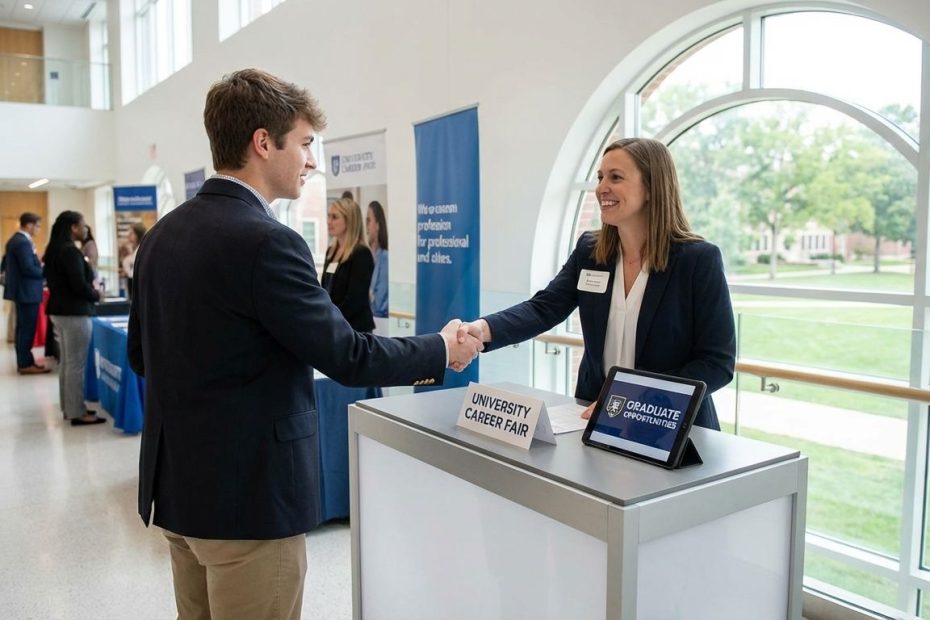
Career fairs pay off when you treat them as a targeted business meeting, not a walk-around. A fair can generate interviews and offers, but only when you plan your employer list, control your introduction, and follow up with specifics that prove you listened. Without that structure, it turns into a long line, a stack of brochures, and a confidence hit.
Walk in with a short list, not “whoever looks interesting.” Pick 5–7 employers, read the job posts they’re actively filling, and prepare one question per employer that can’t be answered by the homepage. That changes you from “another student” into “someone who did the work.” It also makes you more likeable in the practical sense: you respect the recruiter’s time.
Follow-up is where most students lose the ROI. After each conversation, step aside and write quick notes: recruiter name, role discussed, a specific point you learned, and the action you committed to. Use those notes within 24–48 hours to send a tight thank-you and attach the next step you completed, applying online, sending a portfolio link, or booking office hours to refine your resume for that role.
What’s The Fastest Way To Build A Network Before Graduation?
Get into an internship or co-op environment and operate like someone building internal sponsors. Networking accelerates when people see your work repeatedly under real constraints: deadlines, feedback loops, cross-team coordination, and stakeholder communication. That’s where trust forms, and trust is what makes someone refer you without being asked twice.
Internship pipelines convert at meaningful rates, and employer benchmarks show many organizations extend full-time offers to a majority of their intern class in a given year. Recent NACE reporting for the Class of 2024 internship cohort states employers extended offers to 62% of interns on average, with in-person internship programs reporting higher offer rates than hybrid programs. That’s not a promise for any individual student, it’s a signal that internships remain one of the most direct routes from “student” to “hired,” and relationships built inside those programs drive the handoff.
Move from “intern” to “known quantity” by executing three behaviors: document wins weekly, ask for feedback on a schedule, and build lateral connections. Weekly wins give your manager language for performance conversations. Scheduled feedback prevents surprise evaluations. Lateral connections, peers, analysts, coordinators, QA partners, product partners, give you a wider internal network that can advocate for you when headcount opens.
How Do You Ask For An Informational Interview (And What Questions Should You Ask)?
Ask for a short time box and make the request easy to accept. Ten to fifteen minutes is enough to get clarity on what the job really looks like and what skills matter. Offer flexibility on format: phone, video, or written responses. When you reduce effort for the other person, response rates rise.
Use outreach that shows you’re prepared without being verbose. Keep it to six lines: greeting, who you are, why you chose them, the time box, two topics you want to cover, and a low-friction close. One clean close: “If it’s easier, a couple of written answers also helps.” Written answers work well for busy engineers, managers on deadlines, and alumni who travel.
Ask questions that produce actions you can take next week. Avoid questions that invite generic motivation speeches. Strong questions include: “What skills show up daily in your role?” “What does a strong entry-level candidate’s portfolio look like?” “Which classes or projects mapped best to your first year on the job?” “What mistakes did early-career hires make that slowed them down?” “If you were building a candidate from scratch in 90 days, what would you have them ship?”
Operating System: A Practical Networking Plan You Can Run From Freshman Year To Graduation
Networking fails when it lives in your head. You need a simple system that fits into a student schedule and still produces consistent outcomes. The goal is not to “meet everyone,” it’s to build a small number of strong connections plus a wider ring of weak ties that stay warm.
Run a weekly cadence: one reach-out, one live conversation, one follow-up, one portfolio improvement. Put it on the calendar the way you would a lab or practice. The portfolio improvement matters because it turns advice into visible progress, and visible progress is what makes contacts invest more in you.
Track everything in one sheet: name, role, how you met, last touch date, next touch date, notes, and your next action. Your next action is always measurable, apply to X, revise resume bullet Y, build project Z, attend event A. That keeps networking tied to outcomes, not vibes.
How To Use Professors And Teaching Staff Without Making It Weird
Professors become valuable connectors when you show consistency. Office hours once, right before finals, doesn’t build anything. Office hours three times across a semester, with prepared questions and follow-through, does.
Bring specific topics: “I’m comparing these two career paths, what skills should I prioritize?” “Which research methods in this class map to industry roles?” “Could you point to one paper or tool that working teams use?” When you ask at that level, you stand out for seriousness, and staff can recommend you for research, TA roles, scholarships, and introductions.
After the term ends, send a short thank-you and one update per semester. Keep it factual: what you built, what internship you secured, what you’re applying to, and where you need guidance. That’s how you stay top of mind without spamming.
How To Network Through Student Organizations Without Wasting A Year
Student orgs work when you choose roles that produce artifacts. “Member” rarely does. Committee lead, event coordinator, treasurer, project lead, workshop host, those generate output you can show employers and alumni.
Optimize for proximity to professionals. Clubs that run speaker series, case competitions, hack nights, volunteer engagements with sponsors, or alumni mentorship programs are networking machines. You get repeated interactions with the same set of people, which builds familiarity and makes follow-up natural.
Operate like a professional inside the club. Send agendas, run on time, document decisions, and thank guest speakers with a crisp follow-up and a link to outcomes, attendance, feedback, recordings, student questions. People remember students who execute.
How To Build “Likeability” At Events Without Performing A Personality
Likeability in professional settings comes from reliability and attention. You earn it by being easy to talk to, listening well, and respecting time. You don’t need to be loud, clever, or the most social person in the room.
Use a simple conversation loop: ask one targeted question, reflect back what you heard in a sentence, then connect it to your current work. That shows you processed the answer and gives them a reason to remember you. Then close with a clean thank-you and a next step that isn’t burdensome: a connection request, a recommended resource, a quick follow-up question by email.
When you feel nervous, reduce scope instead of forcing confidence. Aim for two strong conversations, not ten weak ones. Two strong conversations with precise follow-up beats a night of scanning name tags and leaving with nothing actionable.
How To Follow Up After Career Fairs, Panels, And Coffee Chats So You Don’t Get Ignored
Your follow-up wins when it is specific and time-bound. “Great meeting you” messages don’t create a reason to respond. A good follow-up references one detail from the conversation and attaches the next step you completed.
Use a three-part structure: appreciation, specificity, action. Appreciation is one sentence. Specificity is the detail that proves this wasn’t a copy-paste. Action is what you did: applied to role ID, updated a project, read the recommended resource, attended an info session. Close with one question that is easy to answer.
Send follow-ups within 24–48 hours. If there’s no response, send one nudge a week later with a meaningful update, not “checking in.” After that, stop. Professional persistence means clear signals and respectful spacing.
How To Turn Weak Ties Into Real Advocates (Referrals Without Begging)
Referrals come from confidence in your execution. People refer candidates when it feels safe for their reputation. You make it safe by showing progress, clarity, and professionalism over time.
Earn advocates by running a “value loop.” Ask for advice, implement it, report back with results, then ask the next better question. That cycle makes someone feel their time matters, and it demonstrates that you can be coached, which is a hiring signal.
When it’s time to ask for a referral, ask cleanly and give them the tools. Provide the job link, a two-sentence fit statement, and a resume that matches the role. If they decline, thank them and keep the relationship intact. That maturity often leads to a different opening later.
How To Network When You’re Introverted Or Commuting Or Working A Job
Networking doesn’t require constant in-person events. It requires repeated contact and visible progress. If your schedule is tight, optimize for shorter interactions with higher preparation.
Use office hours, alumni calls during commute windows, and career center appointments between classes. Attend one high-value event per month rather than many low-value events you can’t follow up on. Your follow-up and execution carry more weight than event volume.
Batch tasks: write three outreach messages in one sitting, schedule two calls for the week, and reserve one hour to update your resume and portfolio based on what you learned. This keeps the machine running even when life is busy.
How To Use Your Internship Like A Return-Offer Campaign (Without Acting Entitled)
Operate with a return-offer mindset from week one: align on expectations, track deliverables, and communicate risks early. Managers advocate for interns who make their life easier, ship useful work, and show steady improvement.
Book a mid-internship check-in with direct questions: “What would make this a strong internship evaluation?” “Where is performance not meeting the bar yet?” “Which stakeholders should know my work?” Those questions surface gaps early, and they show maturity.
Build relationships beyond your manager. Meet adjacent teams, ask how your work affects theirs, and document dependencies. Cross-team visibility matters when teams discuss headcount and when managers compare interns across projects.
How To Avoid Common Networking Mistakes That Waste A Semester
One mistake is waiting until senior year. Professionals can feel pressure when you need a job immediately, and your own stress leaks into the interaction. Start earlier so your questions are exploratory and your tone stays calm.
Another mistake is asking questions that signal you didn’t prepare. “So what does your company do?” burns goodwill fast. Read the job postings, scan recent updates, and ask one question that shows you understand the role’s real work.
A third mistake is failing to convert conversations into visible output. If advice never changes your resume, portfolio, course choices, or interview prep, networking becomes socializing. Make every conversation produce one measurable action within seven days.
How Do You Network In College?
- Meet 1 new professional weekly (professor, alumnus, recruiter)
- Ask 1 specific question, then follow up in 24–48 hours
- Implement 1 action from the advice and report back
Build The Network Before You Need It
Professional connections compound when you show up early, communicate with precision, and follow through fast. Use campus access points, professors, clubs, career services, and alumni tools to create regular conversations that turn into repeat contact. Treat career fairs as targeted meetings, not browsing, and treat informational interviews as a way to gather decision-grade information you can apply to your resume and portfolio. Anchor your fastest growth in internships and co-ops, where your daily execution builds trust and advocacy. Put the whole process into a simple tracking system, then run it weekly until graduation turns your network into a genuine advantage.
References
- ACT: How to Network in College
- University of Pennsylvania Career Services: Make Connections & Network
- University of Pennsylvania Career Services: Network & Gather Information
- Chase: How to Network as a College Student
- University of Minnesota CEHD: Making Connections
- NACE: Intern Offer and Conversion Rates Fall, Acceptances Rise (Aug 11, 2025)
- Binghamton University Fleishman Center: Networking Questions & Outreach Templates
- Reddit: What Do You Do At Career Fairs And How Do You Be Likeable/Stand Out?
- Reddit: How Do Y’all Feel After Attending A Career Fair?
- Reddit: LinkedIn Is Limiting Personalized Messages
- Reddit: CS Student Needing Quick Informational Interview