
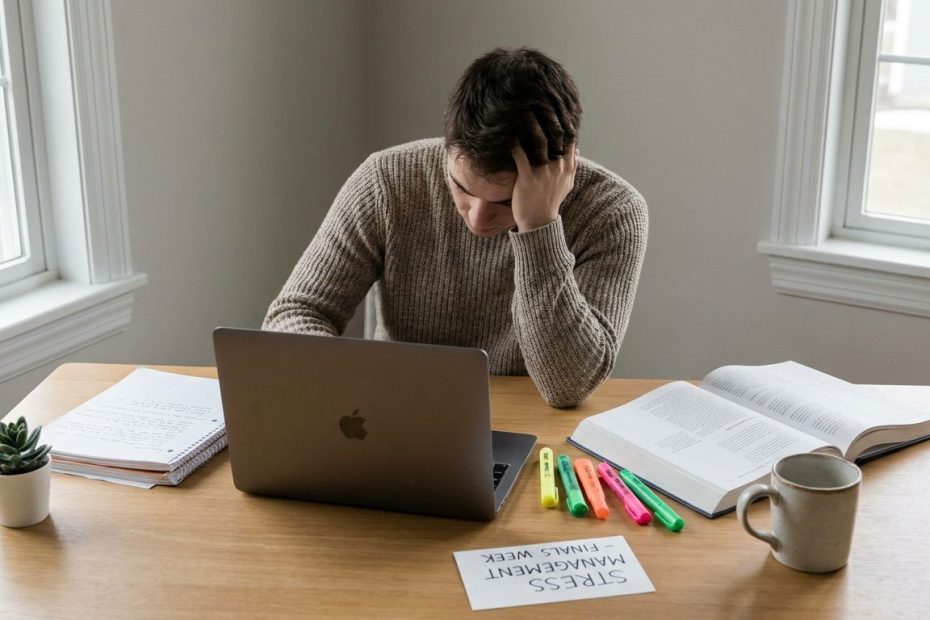
Managing stress during finals week means protecting your brain the same way you protect your grades: with sleep, structure, food, movement, and quick recovery tools you can use under pressure.
You don’t need a perfect routine to get through finals; you need a realistic plan that lowers panic, improves focus, and keeps your body steady enough to perform. This guide gives you practical moves for studying, calming your nervous system, avoiding burnout, and knowing when to reach out for support.
Why Is Finals Week So Stressful For Students?
Finals week feels intense because several demands land at the same time: exams, papers, projects, presentations, grade uncertainty, and reduced downtime. Your brain isn’t just processing academic material; it’s also calculating deadlines, possible outcomes, and the pressure of finishing strong.
That pressure is common. Recent American College Health Association data found that most surveyed college students reported moderate or high stress in the last 30 days, which means finals stress isn’t a personal weakness or a sign that you’re “bad at school.” It’s a predictable response to a compressed academic workload.
The problem starts when stress stops helping you focus and starts blocking your ability to study, sleep, eat, or think clearly. A certain level of alertness can help you prepare, but nonstop tension can interfere with memory, decision-making, and emotional control.
You may notice this shift when you keep rereading the same page without retaining it, jump between tasks without finishing anything, or feel guilty whenever you rest. Those signs mean your system needs a reset, not another hour of frantic studying.
Finals stress also hits harder when your routine disappears. You may skip meals, sleep at odd hours, drink more caffeine, stop moving, and spend less time around supportive people.
Those choices can feel efficient in the moment, but they often reduce performance. Your brain needs fuel, recovery, and structure to pull information from memory during an exam.
The veteran move is to stop treating finals week like a sprint powered by panic. Treat it like a short performance period where energy management matters as much as study time.
You still work hard. You just stop burning the very system you need to use on test day.
How Can You Calm Down Fast During Finals Week?
The fastest way to calm down during finals is to work with your body before arguing with your thoughts. When stress spikes, your breathing often gets shallow, your shoulders tighten, and your attention narrows toward danger.
A short breathing reset can interrupt that cycle. Place both feet on the floor, relax your jaw, inhale for four counts, hold for four counts, and exhale for four counts.
Repeat that pattern five times. Then name one task you can complete in the next 10 minutes.
This is useful because your brain needs a simple next action, not a full life plan, when it’s overloaded. “Review chapter six” may feel too large, but “do five practice problems from chapter six” gives your mind a target.
Grounding also works well when your thoughts feel scattered. Use the 5-4-3-2-1 method: notice five things you see, four things you feel, three things you hear, two things you smell, and one thing you taste.
That sensory scan pulls attention back into the present. You’re no longer locked inside the grade calculator in your head.
If you’re in a library, classroom, or dorm room, keep the reset discreet. Put one hand on your notebook, press your feet into the floor, and slow your exhale longer than your inhale.
A longer exhale signals safety to your body. It won’t erase every worry, but it can lower the volume enough for you to continue.
Movement is another fast stress reliever. A 10-minute walk, stair climb, light stretch, or quick lap around campus can clear the mental fog that comes from sitting too long.
You don’t need a full workout during finals week. You need enough movement to loosen tension and restore focus.
Use a “reset before repeat” rule. When you catch yourself rereading, panicking, scrolling, or staring at the same document, reset for two to five minutes before returning.
That tiny pause saves time. It prevents you from spending an hour pretending to study when your attention left the room 30 minutes earlier.
Should You Pull An All-Nighter Before A Final?
You should usually avoid an all-nighter before a final. Sleep supports memory, focus, mood, and decision-making, which are exactly the skills you need when the exam starts.
Research on students during final exams found that those who averaged at least eight hours of sleep performed better than students who slept less or did not join the sleep challenge. That matters because many students know sleep helps learning but still trade it away under pressure.
The trade often looks logical at midnight. You tell yourself one more hour of notes will rescue the grade.
By morning, that extra hour may cost you speed, recall, patience, and accuracy. You can know the material and still underperform if your brain is running on fumes.
A better rule is simple: stop low-quality studying before it becomes damage. If you’re reading the same paragraph, making careless errors, or feeling wired and foggy at the same time, sleep is the stronger academic move.
You can still make a final pass before bed. Keep it short and targeted: formulas, essay outlines, vocabulary, major themes, or problem types you’re most likely to see.
Then close the loop. Pack your bag, set your alarm, put your materials in one place, and get off your phone.
Your pre-sleep routine matters during finals. A bright screen, group chat panic, and last-minute grade speculation can keep your brain buzzing long after you lie down.
If you can’t sleep right away, don’t turn the night into a second study session. Use calm breathing, a low-light environment, or a short written brain dump to park your thoughts.
Write down the worry, then write the next action. “Worried about biology lab terms. Review flashcards at 7:45.”
That tells your brain the concern has a place to go. You’re not ignoring it; you’re scheduling it.
If you already lost sleep, protect what remains. A short nap may help if you have enough time and it won’t make you late, but don’t let naps replace nighttime recovery across the whole week.
Finals are easier when you stop treating sleep as a reward for being done. Sleep is part of the work.
How Do You Prioritize Studying When Everything Is Due?
When everything feels urgent, prioritize by deadline, grade weight, difficulty, and your current level of readiness. That gives you a practical order instead of letting anxiety choose the loudest task.
Start with a full capture. Write every exam, paper, project, quiz, presentation, and required task in one place.
Do not keep the list in your head. Your memory is already busy; don’t make it carry your whole finals schedule.
Then assign each item a priority score using four questions. What is due soonest? What counts most? What is hardest for you? What is least complete?
A paper worth a large share of your grade and due tomorrow gets attention before a smaller task due later. A subject you struggle with needs active practice sooner than a class where you already have strong command.
After that, break each priority into study blocks. “Study chemistry” is too vague.
“Complete 15 equilibrium problems, check answers, and review mistakes” is clear. Your brain can start that without wasting energy deciding what “study” means.
Use a simple finals triage list: must finish today, should advance today, can schedule later, can reduce or skip if needed. That last category matters.
Students often lose time trying to make every task perfect. Finals week rewards smart completion, not endless polishing.
Set stopping points before you begin. Decide what “done enough for now” means: one practice test reviewed, three pages drafted, office-hours questions written, or flashcards completed twice.
Without stopping points, you may overwork one subject and neglect another. That creates the exact stress spiral you’re trying to avoid.
If you’re juggling multiple deadlines, pair hard tasks with fresh energy. Put problem-solving, writing, and active recall earlier in your strongest study windows.
Save lighter work for lower-energy times. Formatting citations, organizing notes, packing materials, or reviewing a one-page summary can happen when your brain is tired.
Build in a daily “admin sweep.” Spend 10 minutes checking deadlines, exam locations, submission portals, allowed materials, and professor instructions.
This prevents avoidable stress. Nothing spikes panic faster than realizing you studied the right material for the wrong room, time, format, or upload deadline.
What Study Habits Reduce Finals Week Stress?
The study habits that reduce finals stress are the ones that make progress visible. Passive reviewing feels comforting, but active studying gives your brain better retrieval practice.
Use practice questions, blank-page recall, self-quizzing, teaching the concept out loud, and timed problem sets. These methods show you what you can produce without the answer sitting in front of you.
Rereading has a place, but it should not be your main strategy. If you’ve read a chapter twice and still can’t explain it, shift to recall.
Close the book and write what you remember. Then check the gaps.
That gap-checking process is where learning tightens. It may feel harder than highlighting, but it gives you better information about readiness.
Study blocks should be short enough to protect focus. Many students do well with 25 to 50 minutes of work followed by a five to 10-minute break.
During the break, stand up. Get water, stretch, use the restroom, or step outside.
Scrolling can turn a break into a stress trigger, especially when every app is full of comparison. If your “break” leaves you more anxious, it’s not a break.
Use a mistake log for subjects with practice problems. Write the problem type, the mistake, the correct method, and one cue that will help you spot it later.
This turns errors into study material. You stop feeling vaguely behind and start fixing exact weaknesses.
For writing-heavy finals, separate drafting from editing. Drafting requires idea flow; editing requires judgment.
Trying to do them at the same time slows you down. Get the argument or answer structure onto the page, then clean the wording, transitions, and evidence.
For memorization-heavy exams, use spaced repetition across the days you have left. Short, repeated sessions beat one long cram session for most students.
If time is tight, prioritize high-yield material: professor-emphasized topics, study guide items, repeated themes, prior quiz mistakes, and concepts that connect to many other concepts.
You also need food and hydration to study well. Pack simple options: a sandwich, yogurt, fruit, nuts, oatmeal, rice bowl, soup, or any balanced meal you can actually eat.
Finals week is not the time to build a perfect nutrition plan. It is the time to avoid running your brain on caffeine and vending-machine snacks alone.
Caffeine needs boundaries. A moderate amount may help alertness, but too much can increase jitters, racing thoughts, stomach discomfort, and poor sleep.
Energy drinks can worsen anxiety symptoms for some students. If your hands are shaking or your heart is racing, adding more stimulant is not a study strategy.
Protect your study environment, too. Clear one surface, put only the current task in front of you, silence non-urgent alerts, and keep a “later list” for random thoughts.
When your mind says, “Email the professor, wash the hoodie, check the grade portal,” write it down and return to the task. You don’t need to obey every thought the second it appears.
How Do You Stop Panicking During The Actual Exam?
During an exam, your goal is to lower the alarm response enough to think. You don’t need to feel perfectly calm to perform; you need enough control to keep moving.
Start with a 30-second pause. Put both feet on the floor, loosen your grip on the pencil, and take three slow breaths.
Then read the directions slowly. Panic often makes students skip instructions, misread verbs, or answer the wrong number of questions.
Mark the questions you know first. Easy wins restore momentum and give your nervous system evidence that you can answer something.
If a hard question throws you, circle it and move on. Getting stuck early can drain time from questions you know how to handle.
Use a time check that doesn’t become obsession. Divide the exam into rough blocks: first pass, hard-question pass, review pass.
If the test is 60 minutes, you might spend 35 minutes answering what you know, 15 minutes returning to harder items, and 10 minutes checking for skipped questions or careless errors. Adjust the timing to match the format.
For essay exams, outline before writing. A short outline reduces the chance that panic sends you into a long answer with no structure.
Write the thesis, list the main points, then add evidence or reasoning under each point. Once the skeleton is there, your answer becomes easier to build.
For math, science, accounting, or statistics exams, write what you know immediately. Formulas, definitions, units, diagrams, or given values can anchor your thinking.
You may earn partial credit by showing the right setup even if you don’t finish the problem. More than that, writing the setup can unlock the next step.
If your mind blanks, use retrieval cues. Ask yourself: What chapter was this from? What problem type does it resemble? What did the professor repeat? What unit should the answer have?
These prompts help your brain search in organized ways. Panic says “I know nothing,” but cues often reveal that information is still there.
Watch your body language. Hunching, clenching, and shallow breathing can keep the alarm loop active.
Sit back for a moment, drop your shoulders, and slow your exhale. A small physical change can make your thoughts less frantic.
If symptoms feel medically dangerous, treat them seriously. Chest pain, fainting, severe shortness of breath, confusion, or feeling unsafe calls for urgent help, not silent endurance.
If you have documented test anxiety or a health condition that affects exams, contact your school’s accessibility or student support office before finals whenever possible. Approved accommodations work best when arranged ahead of time, not during the crisis moment.
When Should Finals Stress Become A Reason To Get Help?
Finals stress becomes a reason to get help when it interferes with basic functioning or safety. If you can’t sleep for several nights, can’t eat, feel panicked repeatedly, can’t complete daily tasks, or feel like you may hurt yourself, support is needed now.
Getting help is common among students. Recent American College Health Association data shows that many students have used counseling or mental health services, which means you are not the only person needing support during an academic crunch.
Use the right level of support for the situation. For academic confusion, contact a professor, teaching assistant, tutor, academic advisor, or class study group.
For stress that affects your ability to function, contact campus counseling, a student health center, a resident advisor, a trusted family member, or a mental health professional. You don’t need to wait until everything falls apart.
If you feel in immediate danger or may hurt yourself, call 911 or go to the nearest emergency room. In the United States, you can also call, text, or chat 988 for 24/7 crisis support.
Do not talk yourself out of help because finals “will be over soon.” Short-term stress can still become unsafe when your body and mind are overwhelmed.
It’s also time to get help when stress creates avoidance you can’t break. If you’ve missed exams, stopped attending class, ignored every message, or frozen completely on assignments, contact someone today.
Academic staff can often explain options, but they need to hear from you. A short message is better than silence.
You can write: “I’m dealing with serious stress during finals and I’m struggling to complete the work. Can you tell me what options are available?”
Keep it plain. You don’t need a perfect explanation to ask for support.
Reach out to one person first if contacting several offices feels like too much. That person can be a friend, advisor, instructor, counselor, coach, or family member.
Ask for a specific next step: sit with you as you email a professor, walk with you to counseling, help you make a study plan, or help you eat something. Specific support beats vague encouragement.
Finals matter. Your safety matters more.
How Do You Manage Stress During Finals Week?
- Sleep 7 to 9 hours when possible.
- Use short study blocks with breaks.
- Prioritize by deadline and grade weight.
- Use breathing and grounding to calm panic.
- Ask for help if stress feels unsafe.
Protect Your Mind, Protect Your Grade
Finals week is easier to manage when you stop relying on panic and start using a plan that protects focus, sleep, and emotional control. You don’t need perfect discipline; you need clear priorities, short recovery breaks, active study methods, and support when stress becomes too much. Use your body as part of your study system: breathe, eat, move, sleep, and give your brain the conditions it needs to retrieve what you’ve learned. When you finish finals with your health intact, you don’t just survive the week; you build a better way to handle pressure the next time it shows up.
References
- American College Health Association, National College Health Assessment Reference Group Executive Summary
- American Heart Association, finals health guidance
- University of Alabama at Birmingham, finals stress management guidance
- National Center for Complementary and Integrative Health, stress and relaxation research
- Michael K. Scullin, “The Eight Hour Sleep Challenge During Final Exams Week.”
- University of Colorado Boulder, managing stress during finals
- The Jed Foundation, academic stress and crisis support guidance
- Substance Abuse and Mental Health Services Administration, 988 crisis support information
- Mayo Clinic, stress relief and sleep guidance